
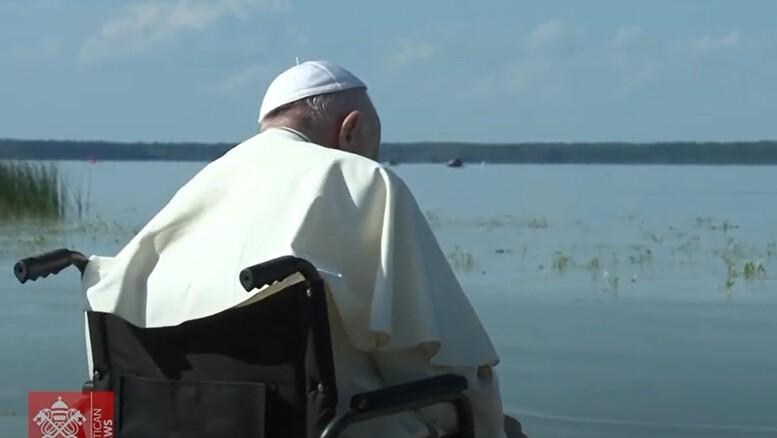
 Questo pomeriggio, lasciato il St. Joseph Seminary, il Santo Padre Francesco si è trasferito in auto al Lac Ste Anne dove – alle ore 17.00 (01.00 ora di Roma) – ha partecipato al Lac Ste Anne Pilgrimage e ha presieduto la Liturgia della Parola.
Al Suo arrivo è stato accolto davanti alla chiesa parrocchiale dal Parroco, dal Sacerdote incaricato dei pellegrinaggi e da alcuni fedeli. Quindi si è diretto verso il lago ed è passato accanto alla statua di Sant’Anna accompagnato dal suono dei tamburi. Giunto al lago, Papa Francesco ha fatto il segno della croce verso i quattro punti cardinali secondo l’usanza degli indigeni e ha benedetto l’acqua del lago. Quindi è arrivato fino al palco da dove – dopo le letture, il salmo responsoriale e la proclamazione del Vangelo – ha pronunciato l’omelia. Quindi, dopo la preghiera dei fedeli, la recita del Padre Nostro e la Benedizione finale, e dopo aver benedetto la statua di Nostra Signora che scioglie i nodi, il Papa è salito sulla papamobile ed è tornato alla chiesa parrocchiale.
Al termine è rientrato in auto al St. Joseph Seminary dove ha cenato in privato.
Pubblichiamo di seguito l’omelia che il Santo Padre ha pronunciato nel corso della Liturgia della Parola:
Queridos hermanos y hermanas, âba-wash-did! Tansi! Oki! [¡buenos días!]
Es hermoso para mí estar aquí, peregrino con ustedes y en medio de ustedes. En estos días, hoy especialmente, me llamó la atención el sonido de los tambores que me han acompañado allí donde he ido. Este latido de los tambores me parecía el eco del latido de muchos corazones. Los corazones que, durante siglos, han vibrado en estas aguas; los corazones de tantos peregrinos que juntos han marcado el paso para alcanzar este “lago de Dios”. Aquí se puede captar el latido coral de un pueblo peregrino, de generaciones que se han puesto en camino hacia el Señor para experimentar su obra de sanación. ¡Cuántos corazones llegaron aquí anhelantes y fatigados, lastrados por las cargas de la vida, y junto a estas aguas encontraron la consolación y la fuerza para seguir adelante! También aquí, sumergidos en la creación, hay otro latido que podemos escuchar, el latido materno de la tierra. Y así como el latido de los niños, desde el seno materno, está en armonía con el de sus madres, del mismo modo para crecer como seres humanos necesitamos acompasar los ritmos de la vida con los de la creación que nos da la vida. Así pues, vayamos de nuevo a nuestras fuentes de vida: a Dios, a los padres y, en el día y en la casa de santa Ana, a los abuelos, que saludo con gran afecto.
Transportados por estos latidos vitales, estamos ahora aquí, en silencio, contemplamos las aguas de este lago. Esto nos ayuda a volver también a las fuentes de la fe. Nos permite peregrinar idealmente hasta los lugares santos. Imaginar a Jesús, que desarrolló gran parte de su ministerio precisamente a la orilla de un lago, el Lago de Galilea. Allí escogió y llamó a los Apóstoles, proclamó las Bienaventuranzas, narró la mayor parte de las parábolas, realizó signos y curaciones. Por otro lado, aquel lago constituía el corazón de la «Galilea de las naciones» (Mt 4,15), una zona periférica, de comercio, donde confluían distintas poblaciones, coloreando la región de tradiciones y cultos dispares. Se trataba del lugar más distante, geográfica y culturalmente, de la pureza religiosa, que se concentraba en Jerusalén, junto al templo. Podemos, pues, imaginar aquel lago, llamado mar de Galilea, como una concentración de diferencias. En sus orillas se encontraban pescadores y publicanos, centuriones y esclavos, fariseos y pobres, hombres y mujeres de las más variadas proveniencias y extracciones sociales. Allí precisamente, precisamente allí, Jesús predicó el Reino de Dios. No a gente religiosa seleccionada, sino a pueblos distintos que, como hoy, acudían de varias partes, predicó acogiendo a todos y en un teatro natural como este. Dios eligió ese contexto poliédrico y heterogéneo para anunciar al mundo algo revolucionario: por ejemplo, “pongan la otra mejilla, amen a los enemigos, vivan como hermanos para ser hijos de Dios, Padre que hace salir el sol sobre buenos y malos y hace caer la lluvia sobre justos e injustos” (cf. Mt 5,38-48). De ese modo, precisamente aquel lago, “mestizado de diversidad”, fue la sede de un inaudito anuncio de fraternidad, de una revolución sin muertos ni heridos, la revolución del amor. Y aquí, en las orillas de este lago, el sonido de los tambores que atraviesa los siglos y une gentes distintas, nos lleva hasta aquel entonces. Nos recuerda que la fraternidad es verdadera si une a los que están distanciados, que el mensaje de unidad que el cielo envía a la tierra no teme las diferencias y nos invita a la comunión, a la comunión de las diferencias, para volver a comenzar juntos, porque todos —¡todos!— somos peregrinos en camino.
Hermanos, hermanas, peregrinos de estas aguas, ¿qué podemos tomar de ellas? La Palabra de Dios nos ayuda a descubrirlo. El profeta Ezequiel ha repetido por dos veces que las aguas que surgen del templo, para el pueblo de Dios, “dan la vida” y “sanan” (cf. Ez 47,8-9).
Dan la vida. Pienso en las abuelas que están aquí con nosotros. Tantas. Queridas abuelas, sus corazones son fuentes de las que surge el agua viva de la fe, con la que han apagado la sed de hijos y nietos. Me admira el papel vital de la mujer en las comunidades indígenas. Ocupan un puesto de mucho relieve en cuanto fuentes benditas de vida, no sólo física sino también espiritual. Y, pensando en sus kokum, pienso en mi abuela. De ella recibí el primer anuncio de la fe y aprendí que el Evangelio se transmite así, a través de la ternura del cuidado y la sabiduría de la vida. La fe raramente nace leyendo un libro nosotros solos en un salón, sino que se difunde en un clima familiar, se transmite en la lengua de las madres, con el dulce canto dialectal de las abuelas. Me alegra ver aquí a tantos abuelos y bisabuelos. Gracias. Se los agradezco, y quisiera decir a cuantos tienen ancianos en casa, en la familia, ¡tienen un tesoro! Custodian entre sus muros una fuente de vida; por favor, háganse cargo de ellos como de la herencia más valiosa para amar y custodiar.
El profeta decía que las aguas, además de dar vida, sanan. Este aspecto nos traslada a las orillas del lago de Galilea, donde Jesús «sanó a muchos enfermos que sufrían de diversos males» (Mc 1,34). Allí, «al ponerse el sol, le llevaban todos los enfermos» (v. 32). Esta tarde imaginémonos alrededor del lago con Jesús, mientras Él se acerca, se inclina y, con paciencia, compasión y ternura, cura tantos enfermos en el cuerpo y en el espíritu: endemoniados, leprosos, paralíticos, ciegos, pero también personas afligidas, descorazonadas, perdidas y heridas. Jesús ha venido y viene todavía a hacerse cargo de nosotros, a consolar y sanar nuestra humanidad sola y agotada. A todos, también a nosotros, dirige la misma invitación: «Vengan a mí todos los cansados y abrumados por cargas, yo los haré descansar» (Mt 11,28). O, como en el texto que hemos escuchado esta tarde: «El que tenga sed, que venga a mí y beba» (Jn 7,37).
Hermanos, hermanas, todos nosotros necesitamos de la sanación de Jesús, médico de las almas y de los cuerpos. Señor, como la gente a la orilla del mar de Galilea no tenía miedo de clamar por sus necesidades, también nosotros, Señor, esta tarde acudimos a ti, con el dolor que llevamos dentro. Te traemos nuestra aridez y nuestras dificultades, te traemos los traumas de la violencia padecida por nuestros hermanos y hermanas indígenas. En este lugar bendito, donde reinan la armonía y la paz, te presentamos las disonancias de nuestra historia, los terribles efectos de la colonización, el dolor imborrable de tantas familias, abuelos y niños. Señor, ayúdanos a sanar nuestras heridas. Sabemos que esto requiere esfuerzo, cuidado y hechos concretos de nuestra parte. Pero sabemos también, Señor, que solos no lo podemos hacer. Nos confiamos a Ti y a la intercesión de tu madre y de tu abuela.
Sí, Señor, nos confiamos a la intercesión de tu madre y de tu abuela, porque las madres y las abuelas ayudan a sanar las heridas del corazón. Durante los dramas de la conquista, fue Nuestra Señora de Guadalupe la que transmitió la recta fe a los indígenas, hablando su lengua, vistiendo sus trajes, sin violencia y sin imposiciones. Y, poco después, con la llegada de la imprenta, se publicaron las primeras gramáticas y catecismos en lenguas indígenas. ¡Cuánto bien han hecho en este sentido los misioneros auténticamente evangelizadores para preservar en muchas partes del mundo las lenguas y las culturas autóctonas! En Canadá, esta “inculturación materna” que se realizó por obra de santa Ana, unió la belleza de las tradiciones indígenas y de la fe, las plasmó con la sabiduría de una abuela, que es dos veces mamá. También la Iglesia es mujer, también la Iglesia es madre. De hecho, nunca hubo un momento en su historia en que la fe no haya sido transmitida, en lengua materna, por las madres y por las abuelas. En cambio, parte de la herencia dolorosa que estamos afrontando nace por haber impedido a las abuelas indígenas transmitir la fe en su lengua y en su cultura. Esta pérdida ciertamente es una tragedia, pero vuestra presencia aquí es un testimonio de resiliencia y de reinicio, de peregrinaje hacia la sanación, de apertura del corazón a Dios que sana nuestro ser comunidad. Hoy, todos nosotros, como Iglesia, necesitamos sanación, necesitamos ser sanados de la tentación de encerrarnos en nosotros mismos, de elegir la defensa de la institución antes que la búsqueda de la verdad, de preferir el poder mundano al servicio evangélico. Hermanos y hermanas, ayudémonos a contribuir para edificar con el auxilio de Dios una Iglesia madre como Él quiere: capaz de abrazar a cada hijo e hija; abierta a todos y que hable a cada uno, a cada una; que no vaya contra nadie, sino que vaya al encuentro de todos.
Las multitudes del lago de Galilea que se agolpaban entorno a Jesús se componían principalmente de gente común, gente sencilla que le llevaba sus propias necesidades y sus propias heridas. De la misma forma, si queremos cuidar y sanar la vida de nuestras comunidades, no podemos comenzar sino desde los pobres, desde los marginados. Con demasiada frecuencia nos dejamos guiar por los intereses de unos pocos que están bien; es necesario mirar más a las periferias y ponerse a la escucha del grito de los últimos, es necesario saber acoger el dolor de los que, muchas veces en silencio, en nuestras ciudades masificadas y despersonalizadas, gritan: “No nos dejen solos”. Es también el grito de los ancianos que corren el peligro de morir solos en casa o abandonados en una estructura, o de los enfermos incómodos a los que, en vez de afecto, se les suministra muerte. Es el grito sofocado de los muchachos y muchachas más cuestionados que escuchados, los cuales delegan su libertad a un teléfono móvil, mientras en las mismas calles otros coetáneos suyos vagan perdidos, anestesiados por alguna diversión, cautivos de adicciones que los vuelven tristes e insatisfechos, incapaces de creer en sí mismos, de amar aquello que son y la belleza de la vida que tienen. No nos dejen solos es el grito de quien quisiera un mundo mejor, pero que no sabe por dónde comenzar.
Jesús, que nos sana y consuela con el agua viva de su Espíritu, esta tarde en el Evangelio nos pide también que de nosotros, desde el seno de quien cree, “broten ríos de agua viva” (cf. v. 38). Y nosotros, ¿sabemos calmar la sed de nuestros hermanos y hermanas? Mientras seguimos pidiendo consuelo a Dios, ¿sabemos darlo también a los demás? ¡Cuántas veces nos liberamos de tantos pesos interiores, por ejemplo, de no sentirnos amados y respetados, cuando comenzamos a amar a los demás gratuitamente! En nuestras soledades e insatisfacciones Jesús nos empuja a salir, nos empuja a dar, nos empuja a amar. Y entonces, me pregunto: ¿qué hago yo por quien me necesita? Mirando a los pueblos indígenas, pensando en sus historias y en el dolor que han sufrido, ¿qué hago yo por ellos? ¿Escucho con curiosidad mundana y me escandalizo por lo que ocurrió en el pasado, o hago algo concreto por ellos? ¿Rezo, leo, me informo, me acerco, me dejo conmover por sus historias? Y, mirándome a mí mismo, si me encuentro en el sufrimiento, ¿escucho a Jesús que me quiere llevar fuera del recinto de mi descontento y me invita a volver a empezar, a superarlo, a amar? A veces, el mejor modo para ayudar a otra persona no es darle enseguida lo que quiere, sino acompañarla, invitarla a amar, a donarse. Porque es así, a través del bien que podría hacer por los demás, que descubrirá sus ríos de agua viva, que descubrirá el tesoro único y valioso que es él mismo.
Queridos hermanos y hermanas indígenas, he venido como peregrino también para decirles lo valiosos que son para mí y para la Iglesia. Deseo que la Iglesia esté entretejida entre nosotros, con la misma fuerza y unión que tienen los hilos de esas franjas coloreadas que tantos de ustedes llevan. Que el Señor nos ayude a ir hacia adelante en el proceso de sanación, hacia un futuro cada vez más saludable y renovado. Creo que sería también el deseo de sus abuelas y de sus abuelos, de nuestros abuelos y de nuestras abuelas. Que los abuelos de Jesús, los santos Joaquín y Ana, bendigan nuestro camino.
Cari fratelli e sorelle, âba-wash-did! Tansi! Oki! [buongiorno]
È bello per me essere qui, pellegrino con voi e in mezzo a voi. In questi giorni, oggi specialmente, sono stato colpito dal suono dei tamburi che mi hanno accompagnato ovunque sono andato. Questo battito dei tamburi mi sembrava echeggiare il battito di molti cuori: i cuori che, nei secoli, hanno vibrato presso queste acque; i cuori di tanti pellegrini che hanno scandito insieme il passo per raggiungere questo “lago di Dio”! Qui si può veramente cogliere il battito corale di un popolo pellegrino, di generazioni che si sono messe in cammino verso il Signore per sperimentare la sua opera di guarigione. Quanti cuori sono giunti qui desiderosi e ansimanti, gravati dai pesi della vita, e presso queste acque hanno trovato la consolazione e la forza per andare avanti! Anche qui, immersi nel creato, c’è un altro battito che possiamo ascoltare, quello materno della terra. E così come il battito dei bimbi, fin dal grembo, è in armonia con quello delle madri, così per crescere da esseri umani abbiamo bisogno di cadenzare i ritmi della vita a quelli della creazione che ci dà vita. Riandiamo così oggi alle nostre sorgenti di vita: a Dio, ai genitori e, nel giorno e nella casa di Sant’Anna, ai nonni, che saluto con grande affetto.
Trasportati da questi battiti vitali, siamo ora qui, in silenzio, contempliamo le acque di questo lago. Esso ci aiuta a tornare anche alle fonti della fede. Ci permette infatti di peregrinare idealmente fino ai luoghi santi: di immaginare Gesù, che svolse gran parte del suo ministero proprio sulle rive di un lago, il Lago di Galilea. Lì scelse e chiamò gli Apostoli, proclamò le Beatitudini, narrò il maggior numero di parabole, compì segni e guarigioni. Ora, quel lago costituiva il cuore della «Galilea delle genti» (Mt 4,15), una zona periferica, di commercio, dove confluivano svariate popolazioni, colorando la regione di tradizioni e culti disparati. Si trattava del luogo più distante, geograficamente e culturalmente, dalla purezza religiosa, che si concentrava a Gerusalemme, presso il tempio. Possiamo dunque immaginare quel lago, chiamato mare di Galilea, come un condensato di differenze: sulle sue rive si incontravano pescatori e pubblicani, centurioni e schiavi, farisei e poveri, uomini e donne delle più variegate provenienze ed estrazioni sociali. Lì, proprio lì, Gesù predicò il Regno di Dio: non a gente religiosa selezionata, ma a popolazioni diverse che accorrevano da più parti come oggi, predicò accogliendo tutti in un teatro naturale come questo. Dio elesse quel contesto poliedrico ed eterogeneo per annunciare al mondo qualcosa di rivoluzionario: per esempio, “porgete l’altra guancia, amate i nemici, vivete da fratelli per essere figli di Dio, Padre che fa splendere il sole sui buoni e sui cattivi e fa piovere sui giusti e sugli ingiusti” (cfr Mt 5,38-48). Così proprio quel lago, “meticciato di diversità”, divenne la sede di un inaudito annuncio di fraternità; di una rivoluzione senza morti e feriti, la rivoluzione dell’amore. E qui, sulle rive di questo lago, il suono dei tamburi che attraversa i secoli e unisce genti diverse, ci riporta fino ad allora. Ci ricorda che la fraternità è vera se unisce i distanti, che il messaggio di unità che il Cielo invia in terra non teme le differenze e ci invita alla comunione, alla comunione delle differenze, per ripartire insieme, perché tutti – tutti! – siamo pellegrini in cammino.
Fratelli, sorelle, pellegrini a queste acque, che cosa possiamo attingervi? Ci aiuta a scoprirlo la Parola di Dio. Il profeta Ezechiele ha ripetuto per due volte che le acque fatte scaturire dal tempio, per il popolo di Dio, “danno la vita” e “risanano” (cfr Ez 47,8-9).
Danno la vita. Penso alle nonne che sono qui con noi, tante! Carissime, i vostri cuori sono sorgenti da cui è scaturita l’acqua viva della fede, con la quale avete dissetato figli e nipoti. Mi colpisce il ruolo vitale delle donne nelle comunità indigene: occupano un posto di rilievo in quanto fonti benedette di vita non solo fisica, ma anche spirituale. E, pensando alle vostre kokum, ripenso anche alla mia nonna. Da lei ho ricevuto il primo annuncio della fede e ho imparato che il Vangelo si trasmette così, attraverso la tenerezza della cura e la saggezza della vita. La fede raramente nasce leggendo un libro da soli in salotto, ma si diffonde in un clima familiare, si trasmette nella lingua delle madri, con il dolce canto dialettale delle nonne. Mi scalda il cuore vedere qui tanti nonni e bisnonni. Grazie! Vi ringrazio e vorrei dire a quanti hanno anziani a casa, in famiglia: avete un tesoro! Custodite tra le vostre mura una sorgente di vita; per favore, prendetevene cura, come dell’eredità più preziosa da amare e custodire.
Il profeta diceva che le acque, oltre a dare vita, risanano. Questo aspetto ci riporta sulle rive del lago di Galilea, dove Gesù «guarì molti che erano affetti da varie malattie» (Mc 1,34). Lì, «venuta la sera, gli portavano tutti i malati» (v. 32). Questa sera immaginiamoci attorno al lago con Gesù, mentre Lui si avvicina, si china e, con pazienza, compassione e tenerezza, guarisce tanti malati nel corpo e nello spirito: indemoniati, lebbrosi, paralitici, ciechi, ma anche persone affrante e sfiduciate, smarrite e ferite. Gesù è venuto e viene ancora a prendersi cura di noi, a consolare e risanare la nostra umanità sola e sfinita. A tutti, anche a noi, rivolge lo stesso invito: «Venite a me, voi tutti che siete stanchi e oppressi, e io vi darò ristoro» (Mt 11,28). O, come nel brano che abbiamo ascoltato stasera: «Se qualcuno ha sete, venga a me e beva» (Gv 7,37).
Fratelli, sorelle, tutti noi abbiamo bisogno della guarigione di Gesù, medico delle anime e dei corpi. Signore, come la gente sulle sponde del mare di Galilea non aveva paura di gridarti i suoi bisogni, così noi stasera, Signore, veniamo a te, con il dolore che abbiamo dentro. Ti portiamo le nostre aridità e le nostre fatiche, ti portiamo i traumi delle violenze subite dai nostri fratelli e sorelle indigeni. In questo luogo benedetto, dove regnano l’armonia e la pace, ti presentiamo le disarmonie delle nostre storie, i terribili effetti della colonizzazione, il dolore incancellabile di tante famiglie, nonni e bambini. Signore, aiutaci a guarire le nostre ferite. Sappiamo che ciò richiede impegno, cura e fatti concreti da parte nostra; ma sappiamo pure, Signore, che da soli non ce la possiamo fare. Ci affidiamo a Te e all’intercessione della tua madre e della tua nonna.
Sì, Signore, ci affidiamo all’intercessione della tua madre e della tua nonna, perché le madri e le nonne aiutano a risanare le ferite del cuore. Durante i drammi della conquista, fu la Madonna di Guadalupe a trasmettere la retta fede agli indigeni, parlando la loro lingua, vestendo i loro abiti, senza violenze e senza imposizioni. E poco dopo, con l’arrivo della stampa, vennero pubblicate le prime grammatiche e i primi catechismi in lingue indigene. Quanto bene hanno fatto in questo senso i missionari autenticamente evangelizzatori per preservare in tante parti del mondo le lingue e le culture autoctone! In Canada, questa “inculturazione materna” è avvenuta per opera di sant’Anna, unendo la bellezza delle tradizioni indigene e della fede, e plasmandole con la saggezza di una nonna, che è mamma due volte. Anche la Chiesa è donna, anche la Chiesa è madre. Non c’è infatti mai stato un momento nella sua storia in cui la fede non fosse trasmessa in lingua materna, dalle madri e dalle nonne. Invece, parte dell’eredità dolorosa che stiamo affrontando nasce dall’aver impedito alle nonne indigene di trasmettere la fede nella loro lingua e nella loro cultura. Questa perdita è certamente una tragedia, ma la vostra presenza qui è una testimonianza di resilienza e di ripartenza, di pellegrinaggio verso la guarigione, di apertura del cuore a Dio che risana il nostro essere comunità. Ora tutti noi, come Chiesa, abbiamo bisogno di guarigione: abbiamo bisogno di essere risanati dalla tentazione di chiuderci in noi stessi, di scegliere la difesa dell’istituzione anziché la ricerca della verità, di preferire il potere mondano al servizio evangelico. Cari fratelli e sorelle, aiutiamoci a dare il nostro contributo per edificare con l’aiuto di Dio una Chiesa madre come a Lui piace: capace di abbracciare ogni figlio e figlia; aperta a tutti e che parli a ciascuno e a ciascuna; che non vada contro qualcuno, ma che vada incontro a chiunque.
Le folle del lago di Galilea che facevano ressa attorno a Gesù erano fatte principalmente di gente comune, gente semplice, che portava a Lui i propri bisogni e le proprie ferite. Similmente, se vogliamo prenderci cura e risanare la vita delle nostre comunità, non possiamo che partire dai poveri, dai più emarginati. Troppo spesso ci si lascia guidare dagli interessi di pochi che stanno bene; occorre guardare di più alle periferie e porsi in ascolto del grido degli ultimi; è necessario saper ascoltare il dolore di quanti, spesso in silenzio, nelle nostre città affollate e spersonalizzate, gridano: “Non lasciateci soli!”. È anche il grido di anziani che rischiano di morire da soli in casa o abbandonati presso una struttura, o di malati scomodi ai quali, al posto dell’affetto, viene somministrata la morte. È il grido soffocato di ragazzi e delle ragazze più interrogati che ascoltati, i quali delegano la loro libertà a un telefonino, mentre nelle stesse strade altri loro coetanei vagano persi, anestetizzati da qualche divertimento, in preda a dipendenze che li rendono tristi e insofferenti, incapaci di credere in sé stessi, di amare quello che sono e la bellezza della vita che hanno. Non lasciateci soli è il grido di chi vorrebbe un mondo migliore, ma non sa da dove iniziare.
Gesù, che ci guarisce e consola con l’acqua viva del suo Spirito, stasera nel Vangelo ci chiede che anche da noi, dal grembo di chi crede, “sgorghino fiumi di acqua viva” (cfr v. 38). E noi, sappiamo dissetare le aridità dei fratelli e delle sorelle? Mentre continuiamo a chiedere consolazione a Dio, sappiamo anche darne agli altri? Quante volte ci liberiamo da tanti pesi interiori, per esempio dal non sentirci amati e rispettati, proprio incominciando ad amare gli altri gratuitamente! Nelle nostre solitudini e insofferenze Gesù ci spinge a uscire, ci spinge a dare, ci spinge ad amare. E allora, mi chiedo: che cosa faccio io per chi ha bisogno di me? Guardando alle popolazioni indigene, pensando alle loro storie e al dolore che hanno subito, che cosa faccio io per loro le popolazioni indigene? Ascolto con un po’ di curiosità mondana e mi scandalizzo per quanto accaduto in passato, oppure faccio qualcosa di concreto per loro? Prego, incontro, leggo, mi documento, mi lascio toccare dalle loro storie? E, guardando a me stesso, se mi trovo nella sofferenza, ascolto Gesù che mi vuole portare fuori dal recinto della mia insofferenza e mi invita a ripartire, ad andare oltre, ad amare? A volte, un bel modo per aiutare un’altra persona è quello di non dargli subito ciò che chiede, ma di accompagnarla, di invitarla ad amare, a farsi dono. Perché è in questo modo che, attraverso il bene che potrà fare agli altri, scoprirà i suoi fiumi di acqua viva, scoprirà il tesoro unico e prezioso che è.
Cari fratelli e sorelle indigeni, sono venuto pellegrino anche per dirvi quanto siete preziosi per me e per la Chiesa. Desidero che la Chiesa sia intrecciata tra di noi, come stretti e uniti sono i fili delle fasce colorate che tanti di voi indossano. Il Signore ci aiuti ad andare avanti nel processo di guarigione, verso un avvenire sempre più risanato e rinnovato. Credo sia anche il desiderio delle vostre nonne e dei vostri nonni, dei nostri nonni e delle nostre nonne. I nonni di Gesù, i santi Gioacchino e Anna, benedicano il nostro cammino.
Dear brothers and sisters, âba-wash-did! Tansi! Oki! [Good day!]
I am very pleased to be here, a pilgrim with you and among you. In these days, and today in particular, I have been struck by the sound of drums that accompanied me wherever I went. This beating of drums seems to echo the beating of so many hearts: hearts that, over the centuries, have beat near these very waters; hearts of the many pilgrims who walked together to reach this “lake of God”! Here we can truly feel the choral heartbeat of a pilgrim people, of generations who set out on a journey towards the Lord in order to experience his work of healing. How many hearts have come here with anxious longing, weighed down by life’s burdens, and found by these waters consolation and strength to carry on! Here, immersed in creation, we can also sense another beating: the maternal heartbeat of the earth. Just as the hearts of babies in the womb beat in harmony with those of their mothers, so in order to grow as people, we need to harmonize our own rhythms of life with those of creation, which gives us life. Today, then, let us return to the sources of life: to God, to our parents and, on this feast day and in the house of Saint Anne, to our grandparents, all of whom I greet with great affection.
Inspired by these vital heartbeats, we are here, silently contemplating the waters of this lake. This too helps us to return to the sources of faith. Indeed, it allows us, in spirit, to visit the holy places: to imagine Jesus, who carried out much of his ministry on the shores of a lake: the Sea of Galilee. There he chose and called the Apostles, preached the Beatitudes, taught many of his parables, performed signs and healings. That lake, the heart of “Galilee of the Gentiles” (Mt 4:15), was nonetheless a peripheral area, a crossroads of commerce where various peoples converged, making the region one of different religions and customs. Geographically and culturally, it was the farthest place from the religious purity concentrated in Jerusalem, around the Temple. So we can think of that lake, the Sea of Galilee, as a place teeming with diversity: fishermen and tax collectors, centurions and slaves, Pharisees and the poor, men and women from a wide variety of origins and social backgrounds, all coming together on its shores. It was precisely there that Jesus preached the kingdom of God: not to a select religious congregation, but to various peoples who then, as today, flocked from different places; in a natural theatre such as this, he preached and welcomed everyone. God chose that richly diverse context to announce to the world something revolutionary: for example, “Turn the other cheek, love your enemies, live as brothers and sisters so as to be children of God, the Father who makes his sun shine on both good and bad and sends rain on the righteous and on the unrighteous” (cf. Mt 5:38-48). This lake, with all its diversity, thus became the site of an unprecedented proclamation of fraternity; not a revolution bringing death and injury in its wake, but a revolution of love. Here, on the shores of this lake, the sound of drums, spanning the centuries and uniting different peoples, brings us back to that time. It reminds us that fraternity is genuine if it unites those who are far apart, that the message of unity that heaven sends down to earth does not fear differences, but invites us to fellowship, a communion of differences, in order to start afresh together, because we are all pilgrims on a journey.
Dear brothers and sisters, pilgrims to these waters, the word of God can help us realize what we can draw from them. The prophet Ezekiel tells us twice that the waters flowing the Temple both “give life” and “heal” God’s people (cf. Ezek 47:8-9).
The waters give life. I think of the many dear grandmothers who are here with us: your hearts are springs from which the living water of faith flowed, and with it you quenched the thirst of your children and grandchildren. I am struck by the vital role of women in indigenous communities: they occupy a prominent place as blessed sources not only of physical but also of spiritual life. In thinking of your kokum, I also remember my own grandmother. From her, I first received the message of faith and learned that the Gospel is communicated through loving care and the wisdom of life. Faith rarely comes from reading a book alone in a corner; instead, it spreads within families, transmitted in the language of mothers, in the sweetly lyrical accents of grandmothers. It warms my heart to see so many grandparents and great-grandparents here. Thank you! I thank you and would like to say to all those families with elderly people at home: you possess a treasure! Guard this source of life within your homes: please take care of it, as a precious legacy to be loved and cherished.
The prophet also said that, in addition to giving life, the waters heal. This too brings us back to the shores of the Sea of Galilee, where Jesus “cured many who were sick with various diseases” (Mk 1:34). When sunset came, “they brought to him all who were sick” (v. 32). This evening, let us picture ourselves around the lake with Jesus, as he draws near, bends down and with patience, compassion and tenderness, heals many who are sick in body or spirit: the possessed, the paralyzed, the blind and lepers, but also the broken-hearted and discouraged, the lost and hurting. Jesus came then, and he still comes now, to care for us, and to console and heal our lonely and wearied human family. To everyone, and to us as well, he extends the same invitation: “Come to me, all you that are weary and are carrying heavy burdens, and I will give you rest” (Mt 11:28). Or, as he says in the passage we heard this evening, “Let anyone who is thirsty come to me, and drink” (Jn 7:37-38).
Brothers and sisters, all of us need the healing that comes from Jesus, the physician of souls and bodies. Lord, as the people on the shores of the Sea of Galilee were not afraid to cry out to you with their needs, so we come to you, Lord, this evening, with whatever pain we bear within us. We bring to you our weariness and our struggles, the wounds of the violence suffered by our indigenous brothers and sisters. In this blessed place, where harmony and peace reign, we present to you the disharmony of our experiences, the terrible effects of colonization, the indelible pain of so many families, grandparents and children. Lord, help us to be healed of our wounds. We know, Lord, that this requires effort, care and concrete actions on our part; but we also know that we cannot do this alone. We rely on you and on the intercession of your mother and your grandmother.
Yes, Lord, we entrust ourselves to the intercession of your mother and your grandmother, because mothers and grandmothers help to heal the wounds of our hearts. At the dramatic time of the conquest, Our Lady of Guadalupe transmitted the true faith to the indigenous people, speaking their own language and clothed in their own garments, without violence or imposition. Shortly afterwards, with the arrival of printing, the first grammar books and catechisms were produced in indigenous languages. How much good was done in this regard by those missionaries who, as authentic evangelizers, preserved indigenous languages and cultures in many parts of the world! In Canada, this “maternal inculturation” took place through Saint Anne, combining the beauty of indigenous traditions and faith, and fashioning them with the wisdom of a grandmother, who is a mother twice over. The Church too is a woman, a mother. In fact, there has never been a time in her history when the faith was not passed on in mother tongues, passed on by mothers and grandmothers. Yet, part of the painful legacy we are now confronting stems from the fact that indigenous grandmothers were prevented from passing on the faith in their own language and culture. That loss was certainly tragic, but your presence here is a testimony of resilience and a fresh start, of pilgrimage towards healing, of a heart open to God who heals the life of communities. All of us, as Church, now need healing: healing from the temptation of closing in on ourselves, of defending the institution rather than seeking the truth, of preferring worldly power to serving the Gospel. Dear brothers and sisters, with God’s help, let us help one another in offering our own contribution to the building up of a Mother Church pleasing to him: capable of embracing each of her sons and daughters; a Church that is open to all and speaks to everyone; a Church that is against no one, and encounters everyone.
The crowds at the Sea of Galilee who thronged around Jesus were made up for the most part of ordinary, simple people, who brought to him their own needs and hurts. If we want to care for and heal the life of our communities, we need to start with the poor and most marginalized. Too often, we allow ourselves to be guided by the interests of a few who are comfortable. We need to look more to the peripheries and listen to the cry of the least of our brothers and sisters. We need to learn how to listen to the pain of those who, in our crowded and depersonalized cities, often silently cry out: “Don’t abandon us!” It is also the plea of the elderly who risk dying alone at home or in a nursing home. Of patients who, in place of affection, are administered death. It is the muffled plea of young people who are more interrogated than listened to, who delegate their freedom to a cell phone, while in the same streets other young people wander about, lost, aimless, prey to addictions that only make them depressed and frustrated, unable to believe in themselves or to love themselves for who they are, or to appreciate the beauty of their lives. Don’t abandon us! That is the cry of those who want a better world but do not know where to start.
In this evening’s Gospel, Jesus, who heals and consoles us with the living water of his Spirit, asks that from us too, from the hearts of those who believe in him, “streams of living water might flow” (cf. v. 38). Yet, are we able to quench the thirst of our brothers and sisters? While we continue to ask God for consolation, are we also able to bring consolation to others? It often happens that we free ourselves from many inner burdens, from not feeling loved or respected, for example, simply by starting to love others freely. When we are lonely and restless, Jesus urges us to go out, to give, to love. So, let us ask ourselves: what do I do for those who need me? When looking at the indigenous peoples and thinking of their history and the pain that they endured, what do I do for indigenous peoples? Do I merely listen with curiosity, horrified by what happened in the past, or do I do something concrete for them? Do I pray, meet, read, support them, and let myself be touched by their stories? Looking at my own life, if I find myself suffering, do I listen to Jesus who wants to take me beyond the confines of my impatience, who invites me to start over again, to go a step further, to love? Sometimes, a good way to help others is not immediately to give them what they ask for, but to accompany them, inviting them to love, and to give of themselves. In this way, through the good they can do for others, they will discover their own streams of living water, and the unique and precious treasure that they truly are.
Dear indigenous brothers and sisters, I have come here as a pilgrim also to say to you how precious you are to me and to the Church. I want the Church to be intertwined among us, as tightly woven as the threads of the colored bands that many of you wear. May the Lord help us to move forward in the healing process, towards an ever more healthy and renewed future. I believe that this is also the wish of your grandmothers and your grandfathers and of our grandfathers and our grandmothers. May the grandparents of Jesus, Saints Joachim and Anne, bless us on our journey.
Liebe Brüder und Schwestern, âba-wash-did! Tansi! Oki! [Guten Tag].
Es ist schön für mich, hier zu sein, als Pilger mit euch und in eurer Mitte. In diesen Tagen, und vor allem heute, war ich beeindruckt vom Klang der Trommeln, die mich überallhin begleiteten, wo ich hinging. Dieser Trommelschlag schien mir das Echo vieler Herzen zu sein: die Herzen, die im Laufe der Jahrhunderte an diesen Gewässern pulsiert haben; die Herzen so vieler Pilger, die sich zusammengetan haben, um diesen „See Gottes“ zu erreichen! Hier kann man wirklich den gemeinsamen Herzschlag eines Pilgervolkes wahrnehmen, von Generationen, die sich auf den Weg zum Herrn gemacht haben, um sein heilendes Wirken zu erfahren. Wie viele Menschenherzen sind hierhergekommen, sehnsüchtig und außer Atem, von der Last des Lebens niedergedrückt, und haben an diesem Wasser Trost und Kraft gefunden, um weiterzugehen! Auch hier, inmitten der Schöpfung, können wir einen anderen Schlag hören, den mütterlichen Herzschlag der Erde. Und so wie der Herzschlag der Kinder vom Mutterleib an mit dem ihrer Mütter harmoniert, müssen wir, um als Menschen zu wachsen, die Rhythmen des Lebens mit denen der Schöpfung, die uns das Leben schenkt, in Einklang bringen. So kehren wir heute zu den Quellen unseres Lebens zurück: zu Gott, zu den Eltern und am Tag und im Haus der heiligen Anna zu den Großeltern, die ich sehr herzlich grüße.
Getragen von diesen lebenswichtigen Herzschlägen sind wir nun hier, in der Stille, und betrachten das Wasser dieses Sees. Es hilft uns, auch zu den Quellen des Glaubens zurückzukehren. Es ermöglicht uns, in Gedanken zu den heiligen Stätten zu pilgern: Wir können uns Jesus vorstellen, der einen großen Teil seines Wirkens gerade an den Ufern eines Sees, dem See Gennesaret, ausgeübt hat. Dort wählte und berief er die Apostel, verkündete die Seligpreisungen, erzählte die meisten Gleichnisse, tat Zeichen und Heilungen. Dieser See bildete das Zentrum des „heidnischen Galiläas“ (Mt 4,15), ein peripheres Handelsgebiet, in dem verschiedene Bevölkerungsgruppen zusammenflossen und die Region mit unterschiedlichen Traditionen und Kultformen gestalteten. Es war der geografisch und kulturell am weitesten von der religiösen Reinheit entfernte Ort, die sich in Jerusalem im Tempel bündelte. Wir können uns also jenen See, der Galiläisches Meer genannt wurde, als ein Kondensat von Unterschiedlichkeiten vorstellen: An seinen Ufern trafen Fischer und Zöllner aufeinander, Zenturien und Sklaven, Pharisäer und Arme, Männer und Frauen unterschiedlichster Herkunft und sozialer Schichten. Dort, genau dort, hat Jesus das Reich Gottes gepredigt: nicht ausgewählten religiösen Menschen, sondern verschiedenen Bevölkerungsgruppen, die so wie heute von zahlreichen Gegenden herbeieilten; er hat alle willkommen geheißen und ihnen vor einer Naturbühne, so wie hier, gepredigt. Gott hat dieses vielseitige und heterogene Umfeld gewählt, um der Welt etwas Revolutionäres zu verkünden, so zum Beispiel: „Haltet die andere Wange hin, liebt die Feinde, lebt als Brüder und Schwestern, um Kinder Gottes zu sein, des Vaters, der die Sonne aufgehen lässt über Guten und Bösen und es regnen lässt über Gerechte und Ungerechte“ (vgl. Mt 5,38-48). So wurde gerade dieser See, „ein Schmelztiegel der Verschiedenheiten“, zum Schauplatz einer noch nie dagewesenen Verkündigung der Geschwisterlichkeit, einer Revolution ohne Tote und Verletzte, der Revolution der Liebe. Und hier, an den Ufern dieses Sees, versetzt uns der Klang der Trommeln, der die Jahrhunderte überdauert und die verschiedenen Völker vereint, bis in diese Zeit zurück. Er erinnert uns daran, dass die Geschwisterlichkeit echt ist, wenn sie diejenigen vereint, die weit voneinander entfernt sind, dass die Botschaft der Einheit, die der Himmel auf die Erde sendet, keine Angst vor Verschiedenheiten hat und uns zur Gemeinschaft einlädt, zur Gemeinschaft der Unterschiede, um gemeinsam wieder aufzubrechen, weil wir alle – alle! - Pilger auf dem Weg sind.
Brüder, Schwestern, Pilger zu diesen Gewässern, was können wir aus ihnen schöpfen? Das Wort Gottes hilft uns, es zu entdecken. Der Prophet Ezechiel wiederholt zweimal, dass die Wasser, die aus dem Tempel fließen, für das Volk Gottes „Leben spenden“ und „heilen“ (vgl. Ez 47,8-9).
Sie spenden Leben. Ich denke an die Großmütter, die hier unter uns sind, viele! Ihr Lieben, eure Herzen sind Quellen, aus denen das lebendige Wasser des Glaubens geflossen ist, mit dem ihr den Durst eurer Kinder und Enkelkinder gestillt habt. Ich bin beeindruckt von der lebenswichtigen Rolle der Frauen in den indigenen Gemeinschaften: Sie nehmen eine herausragende Stellung als gesegnete Quellen nicht nur des physischen, sondern auch des geistlichen Lebens ein. Und wenn ich an eure Kokum denke, denke ich auch an meine Großmutter. Von ihr habe ich die erste Verkündigung des Glaubens erhalten und gelernt, dass das Evangelium auf diese Weise weitergegeben wird, durch die Warmherzigkeit der Fürsorge und die Weisheit des Lebens. Der Glaube entsteht selten durch das einsame Lesen eines Buches im Wohnzimmer, sondern verbreitet sich in einer familiären Atmosphäre, er wird in der Sprache der Mütter mit dem sanften Gesang im Dialekt der Großmütter vermittelt. Es erwärmt mein Herz, so viele Großeltern und Urgroßeltern hier zu sehen. Danke! Ich danke euch und möchte denjenigen, die ältere Menschen zu Hause, in der Familie haben, sagen: Ihr habt einen Schatz! Ihr bewahrt innerhalb eurer Mauern eine Quelle des Lebens; bitte, sorgt euch um sie wie um das kostbarste Erbe, das geliebt und behütet werden muss.
Der Prophet sagte, dass die Wasser nicht nur Leben spenden, sondern auch heilen. Dies führt uns zurück an die Ufer des Sees Gennesaret, wo Jesus viele »heilte […], die an allen möglichen Krankheiten litten« (Mk 1,34). Dort geschah dies: »Am Abend, als die Sonne untergegangen war, brachte man alle Kranken und Besessenen« zu ihm (V. 32). Stellen wir uns heute Abend vor, wie wir mit Jesus am See sind, wie er sich nähert, sich herabneigt und mit Geduld, Mitgefühl und Sanftheit so viele Kranke an Körper und Geist heilt: die Besessenen, die Aussätzigen, die Gelähmten, die Blinden, aber auch Menschen, die gebrochen und entmutigt, verloren und verwundet sind. Jesus ist gekommen und kommt immer noch, um sich um uns zu sorgen, um unsere einsame und ermattete Menschheit zu trösten und zu heilen. An alle, auch an uns, richtet er dieselbe Einladung: »Kommt alle zu mir, die ihr mühselig und beladen seid! Ich will euch erquicken« (Mt 11,28). Oder wie in dem Abschnitt, den wir heute Abend gehört haben: »Wer Durst hat, komme zu mir und […] trinke« (Joh 7,37).
Brüder und Schwestern, wir alle bedürfen der Heilung durch Jesus, den Arzt der Seele und des Leibes. Herr, so wie die Menschen am Ufer des Sees Gennesaret sich nicht scheuten, mit ihren Nöten zu dir zu rufen, so kommen wir heute Abend, o Herr, mit unserem inneren Schmerz zu dir. Wir bringen dir unsere Trockenheit und Mühsal, wir bringen dir die Traumata der Gewalt, die unsere indigenen Brüder und Schwestern erlitten haben. An diesem gesegneten Ort, an dem Einklang und Frieden herrschen, bringen wir dir den Missklang unserer Geschichte, die schrecklichen Auswirkungen der Kolonialisierung, den unauslöschlichen Schmerz so vieler Familien, Großeltern und Kinder. Herr, hilf uns, unsere Wunden zu heilen. Wir wissen, dass dies Engagement, Sorgfalt und Handeln von unserer Seite aus erfordert, aber wir wissen auch, o Herr, dass wir es nicht allein schaffen können. Wir vertrauen uns dir und der Fürbitte deiner Mutter und Großmutter an.
Ja, Herr, wir vertrauen uns der Fürsprache deiner Mutter und deiner Großmutter an, denn die Mütter und Großmütter helfen, die Wunden des Herzens zu heilen. Während der Tragödien der Eroberung war es Unsere Liebe Frau von Guadalupe, die den Indigenen den rechten Glauben vermittelte, indem sie ihre Sprache sprach und ihre Kleidung trug, ohne Gewalt anzuwenden oder ihnen etwas aufzuzwingen. Und kurz darauf wurden mit der Einführung des Buchdrucks die ersten Grammatiken und Katechismen in den indigenen Sprachen veröffentlicht. Wie gut haben es die authentisch evangelisierenden Missionare in dieser Hinsicht geschafft, die einheimischen Sprachen und Kulturen in so vielen Teilen der Welt zu erhalten! In Kanada hat diese „mütterliche Inkulturation“ durch das Wirken der heiligen Anna stattgefunden, die die Schönheit der einheimischen Traditionen und des Glaubens miteinander verband und sie mit der Weisheit einer Großmutter, die eine zweifache Mutter ist, formte. Auch die Kirche ist Frau, auch die Kirche ist Mutter. In der Tat hat es in ihrer Geschichte nie eine Zeit gegeben, in der der Glaube nicht in der Muttersprache, von Müttern und Großmüttern, weitergegeben wurde. Dagegen rührt ein Teil des schmerzlichen Erbes, mit dem wir konfrontiert sind, daher, dass die indigenen Großmütter daran gehindert wurden, den Glauben in ihrer eigenen Sprache und Kultur weiterzugeben. Dieser Verlust ist gewiss eine Tragödie, aber eure Anwesenheit hier ist ein Zeugnis der Resilienz und des Neuaufbruchs, der Pilgerschaft zur Heilung, der Öffnung unserer Herzen für Gott, der unser Sein in Gemeinschaft heilt. Jetzt bedürfen wir alle als Kirche der Heilung: wir bedürfen der Heilung von der Versuchung, uns in uns selbst zu verschließen, die Verteidigung der Institution anstatt die Suche nach der Wahrheit zu wählen, weltliche Macht dem Dienst am Evangelium vorzuziehen. Liebe Brüder und Schwestern, helfen wir einander unseren Beitrag zu leisten, um mit Gottes Hilfe eine mütterliche Kirche aufzubauen, so wie sie ihm wohlgefällig ist: fähig, jeden Sohn und jede Tochter zu umarmen; offen für alle und zu jedem und jeder sprechend; nicht gegen jemanden gehend, sondern jedem entgegenkommend.
Die Menschenmenge am See von Galiläa, die sich um Jesus drängte, bestand hauptsächlich aus einfachen Menschen, die ihre Nöte und Wunden zu ihm brachten. Wenn wir uns um das Leben in unseren Gemeinschaften kümmern wollen und es heilen wollen, können wir ebenfalls nur bei den Armen und den Ausgegrenzten anfangen. Zu oft lassen wir uns von den Interessen der Wenigen leiten, denen es gut geht; wir müssen mehr auf die Peripherie schauen und auf den Schrei der Geringsten hören; wir müssen es verstehen, auf den Schmerz derer zu hören, die in unseren überfüllten und entpersönlichten Städten oft in Stille schreien: „Lasst uns nicht allein!“ Das ist auch der Schrei der älteren Menschen, die Gefahr laufen, allein zu Hause zu sterben oder in einer Einrichtung zurückgelassen zu werden, oder der unbequemen kranken Menschen, denen statt Zuneigung Tod verabreicht wird. Es ist der unterdrückte Schrei junger Menschen, die mehr abgefragt als angehört werden, die ihre Freiheit an ein Mobiltelefon abgeben, während andere in ihrem Alter auf denselben Straßen verloren herumstreunen, betäubt von irgendeinem Vergnügen, in den Fängen von Süchten, die sie traurig und ungeduldig machen, unfähig, an sich selbst zu glauben, zu lieben, was sie sind, und die Schönheit des Lebens, das sie haben. Lasst uns nicht allein ist der Schrei derer, die eine bessere Welt wollen, aber nicht wissen, wo sie anfangen sollen.
Jesus, der uns mit dem lebendigen Wasser seines Geistes heilt und tröstet, bittet uns im heutigen Evangelium darum, dass auch aus uns, aus dem Schoß derer, die glauben, »Ströme von lebendigem Wasser fließen« (vgl. V. 38). Und wir, wissen wir, wie wir den Durst unserer Brüder und Schwestern stillen können? Während wir Gott weiterhin um Trost bitten, wissen wir auch, wie wir ihn anderen spenden können? Wir oft befreien wir uns von so vielen inneren Lasten, zum Beispiel davon, dass wir uns nicht geliebt und respektiert fühlen, gerade indem wir beginnen, andere ohne Gegenleistung zu lieben! In unserer Einsamkeit und Ungeduld fordert Jesus uns auf, hinauszugehen, er fordert uns auf, zu geben, er fordert uns auf, zu lieben. Und so frage ich mich: Was tue ich für diejenigen, die mich brauchen? Wenn ich auf die indigenen Bevölkerungen blicke, über ihre Geschichten und das Leid, das sie erlitten haben, nachdenke, was tue ich für sie, für die indigenen Bevölkerungen? Höre ich mit etwas weltlicher Neugierde zu und bin ich empört über das, was in der Vergangenheit geschehen ist, oder tue ich etwas Konkretes für sie? Bete ich, treffe ich mich, lese ich, dokumentiere ich mich, lasse ich mich von ihren Geschichten berühren? Und im Blick auf mich selbst: Wenn ich mich im Leid befinde, höre ich dann auf Jesus, der mich aus der Umzäunung meiner Ungeduld herausholen und mich einladen will, neu anzufangen, weiterzugehen, zu lieben? Manchmal findet sich eine schöne Art, einem anderen Menschen zu helfen, nicht darin, ihm sofort das zu geben, worum er bittet, sondern ihn zu begleiten und einzuladen, zu lieben und sich selbst zur Gabe zu machen. Denn so wird er durch das Gute, das er anderen zu tun vermag, die eigenen Ströme lebendigen Wassers entdecken, den einzigartigen und kostbaren Schatz, der er selbst ist.
Liebe indigene Brüder und Schwestern, ich bin als Pilger gekommen, um euch auch zu sagen, wie wertvoll ihr für mich und für die Kirche seid. Ich wünsche mir, dass die Kirche unter uns so verflochten sei, so eng verwoben und vereint wie die Fäden der bunten Bänder, die so viele von euch tragen. Möge der Herr uns helfen, im Heilungsprozess voranzukommen, hin zu einer immer heileren und erneuerten Zukunft. Ich glaube, das ist auch der Wunsch eurer Großmütter und Großväter, unserer Großväter und Großmütter. Mögen die Großeltern Jesu, die heiligen Joachim und Anna, unseren Weg segnen.
الزيارة الرسوليّة إلى كندا
عظة قداسة البابا فرنسيس
في المشاركة في ”الحجّ إلى بحيرة القدّيسة حنّة“ وليتورجيا الكلمة
في ”بحيرة القدّيسة حنّة“
الثلاثاء 26 تموز/يوليو 2022
أيّها الإخوة والأخوات الأعزّاء، صباح الخير!
حسَنٌ أن أكون هنا، حاجًّا معكم وبينكم. في هذه الأيام، وخاصّة اليوم. تأثّرت من صوت الطبول التي رافقتني في كلّ مكان ذهبت إليه. بدا لي قرع الطبول وكأنّه يردّد خفقات القلوب الكثيرة التي خفقت على مرّ القرون بالقرب من هذه المياه، قلوب الحجاج الكثيرين الذين ساروا بخطوات منتظمة معًا للوصول إلى ”بحيرة الله“! هنا يمكن حقًا سماع نبض قلوب شعب حاجّ، لأجيال انطلقت في مسيرة نحو الرّبّ يسوع لتختبر عمله الشافيّ. كم من القلوب التي أتت إلى هنا راغبة متلهفّة، مثقلة بأعباء الحياة، وبالقرب من هذه المياه وجدت العزاء والقوّة للمضي قُدُمًا! وهنا أيضًا، في غمار الخليقة، قلبٌ آخر يخفق يمكن أن نسمعه، إنّه خفقان أمّنا الأرض. وهكذا كما أن خفقات قلب الأطفال، في الرّحم، تنسجم مع خفقات قلب الأمهات، كذلك، لكي ننمو كبشر، نحتاج إلى ضبط إيقاعات الحياة لتكون منسجمة مع إيقاعات الخليقة التي تمنحنا الحياة. فلنعد اليوم إلى ينابيع حياتنا: لنعد إلى الله، وإلى الوالدين، وفي يوم وفي بيت القدّيسة حنّة، لنعد إلى الأجداد، الذين أحيّيهم بمودّة كبيرة.
سرنا مع هذه القلوب النابضة بالحياة، ونحن الآن هنا، في صمت، نتأمّل في مياه هذه البحيرة. الصّمت يساعدنا في العودة أيضًا إلى ينابيع الإيمان. في الواقع، الصّمت يسمح لنا بأن نتجوَل بالرّوح في الأماكن المقدّسة: فنتخيّل يسوع، الذي حمل جزءًا كبيرًا من رسالته على ضفاف البحيرة، بحيرة الجليل. هناك اختار الرّسل ودعاهم، وأعلن التّطويبات، وروى أكبر عدد من الأمثال، وأتمّ الآيات والشفاءات. كانت تلك البحيرة بمثابة قلب "جَليل الأمم" (متّى 4، 15)، منطقة على الأطراف، للتجارة، حيث كان تلتقي شعوب عديدة، تركت في المنطقة تقاليد وعبادات مختلفة. وكانت أبعد مكان جغرافيًا وثقافيًا عن الطّهارة الدينيّة التي تركزّت في أورشليم، بالقرب من الهيكل. لنتصوَّر تلك البحيرة، التي تُسمّى بحيرة الجليل، والتي كانت تلخص الاختلافات: على ضفافها اجتمع الصّيادون وجباة الضرائب، وقادة الجيش والعبيد، والفريسيّون والفقراء، والرّجال والنساء من مختلف الأصول والخلفيات الاجتماعيّة. هناك، بالتّحديد هناك، بشّر يسوع بملكوت الله: لم يبشّر أناسًا متديّنين مختارين، بل بشّر شعوبًا مختلفة توافدت من أنحاء مختلفة مثل اليوم، بشّر واستقبل الجميع في مشهد طبيعيّ مثل هذا. اختار الله تلك البيئة متعدّدة الأوجه وغير المتجانسة ليعلن شيئًا ثوريًا للعالم: مثلًا، ”حوِّل له خدك الآخر، وأَحِبُّوا أَعداءَكم، وعيشوا مثل الإخوة لتكونوا أبناء الله، وأبيكم الذي يُطلِعُ شَمْسَه على الأَشرارِ والأَخيار، ويُنزِلُ المطر على الأَبرارِ والفُجَّار“ (راجع متّى 5، 38-48). وهكذا بالتّحديد أصبحت تلك البحيرة، ”وفيها خليط من الاختلافات“، مقرًّا لإعلان الأخوّة التي لم يُسمع بها من قبل، ومقرًّا لثورة بلا قتلى وجرحى، بل ثورة حبّ. وهنا، على ضفاف هذه البحيرة، يعيدنا صوت الطبول إلى ذلك الوقت، صوت الطبول الذي يعبر القرون ويوحّد أناسًا مختلفين. صوت الطبول يذكّرنا أنّ الأخوّة صحيحة إن وحّدت البعيدين، وأنّ رسالة الوَحدة التي ترسلها السّماء إلى الأرض لا تخشى الاختلافات، ويدعونا إلى الشّركة والوَحدة، لنبدأ معًا من جديد، لأنّنا جميعًا حجّاج على الطريق.
أيّها الإخوة والأخوات، حجّاج هذه المياه، ماذا يمكن أن نستمد منها؟ كلمة الله تساعدنا على اكتشاف ذلك. كرّر النبي حزقيال مرتَين أنّ المياه التي تتدفّق من الهيكل، من أجل شعب الله، ”تمنح الحياة“ و ”تشفي“ (راجع حزقيال 47، 8-9).
تمنح الحياة. أفكّر في الجدات الحاضرات معنا هنا: الجدات العزيزات، قلوبكن ينبع منها ماء الإيمان الحيّ، الذي تروون به عطش الأبناء والأحفاد. لقد أثّر فيَّ دور النساء الحيويّ في جماعات السّكان الأصليّين: فقد احتلّت النساء مكانة بارزة بكونهن ينابيع مباركة ليس فقط للحياة الماديّة بل أيضًا للحياة الروحيّة. وبالتفكير في ”كوكوم“، في جداتكم، أفكّر أيضًا في جدتي. منها تلقيت أوّل إعلان للإيمان وتعلّمت أنّ الإنجيل ينتقل بهذه الطريقة، من خلال حنان العنايّة وحكمة الحياة. نادرًا ما يولد الإيمان من قراءة كتاب ونحن وحدنا في غرفة الاستقبال، بل ينتشر الإيمان في جو عائليّ، وينتقل بلغة الأمهات، وبأغنيّة الجدات العذبة. يسعدني أن أرى الكثير من الأجداد ووالدي الأجداد هنا. شكرًا! أشكركم وأودّ أن أقول لكلّ مَن لديه كبير في السّنّ في البيت وفي العائلة: لديكم كنز! حافظوا على ينبوع الحياة داخل جدران بيوتكم؛ ومن فضلكم، اعتنوا بهم، باعتبارهم أثمن ميراث يجب أن تحبّوه وتحافظوا عليه.
قال النبّي إنّ المياه، بالإضافة إلى أنّها تمنح الحياة، فإنّها تشفي. هذا الجانب يعيدنا إلى ضفاف بحيرة الجليل، حيث يسوع "شَفى كثيرًا مِنَ المَرْضى المُصابينَ بِمُخَتَلِفِ العِلَل" (مرقس 1، 34). هناك، "وعِندَ المَساء بَعدَ غُروبِ الشَّمْس، أَخَذَ النَّاسُ يَحمِلونَ إِلَيه جَميعَ المَرْضى" (الآية 32). لنتخيّل هذه الليلة أنفسنا حول البحيرة مع يسوع، عندما كان يقترب، وينحني، بصبر ورحمة وحنان، ويشفي المرضى الكثيرين في الجسد والرّوح: الممسوسين، والبرص، والمشلولين، والعميان، وأيضًا المرهقين، والمحبَطين، والتائهين والجرحى. جاء يسوع ولا يزال يأتي ليهتمّ بنا ويعزيّ ويشفيّ إنسانيتنا المنعزلة والمنهكة. ويوجّه إلى الجميع، وأيضًا إلينا، نفس الدعوة، فيقول: "تَعالَوا إِليَّ جَميعاً أَيُّها المُرهَقونَ المُثقَلون، وأَنا أُريحُكم" (متّى 11، 28). أو كما في المقطع الذي أصغينا إليه هذا المساء، يقول: "إِن عَطِشَ أَحَدٌ فليُقبِلْ إِلَيَّ" (يوحنّا 7، 37).
أيّها الإخوة والأخوات، نحن جميعًا بحاجة إلى شفاء يسوع، طبيب النفوس والأجساد. يا ربّ، مثل الجموع على ضفاف بحيرة الجليل، التي لم تخشَ أن تصرخ بحاجاتها، كذلك نأتي إليك هذا المساء، مع الألم الذي في داخلنا. نحمل لك جفافنا وتعبنا، ونحمل لك صدمات العنف التي عانى منها إخوتنا وأخواتنا من السّكان الأصليّين. في هذا المكان المبارك، حيث يسود الوئام والسّلام، نقدّم لك عدم الانسجام في تاريخنا، وآثار الاستعمار الرّهيبة، والألم الذي لا يُمحى للعديد من العائلات والأجداد والأطفال. يا ربّ، ساعدنا في شفاء جراحنا. نحن نَعلم أنّ هذا يتطلّب التزامًا وعناية وأعمالًا ملموسة من جانبنا؛ لكنّنا نَعلم أيضًا، يا ربّ، أنّه لا يمكننا القيام بذلك وحدنا. نحن نوكل أنفسنا إليك وإلى شفاعة والدتك وجدتك.
نعم، يا ربّ، نحن نوكل أنفسنا إلى شفاعة والدتك وجدتك، لأنّ الأمهات والجدات يساعدن في شفاء جروح القلب. خلال مأساة الغزو والاحتلال، كانت سيّدتنا مريم العذراء، سيّدة غوادالوبي، هي التي نقلت الإيمان الصّحيح إلى السّكان الأصليّين، فتكلّمت بلغتهم ولبست لِبسَهم، دون أن تستعمل معهم الشدّة ودون أن تفرض عليهم شيئًا. وبعد فترة وجيزة، مع وصول جهاز الطباعة، نُشرت أولى القواعد النحويّة والتعلّيم المسيحيّ بلغات السّكان الأصليّين. كم هو الخير الذي قام به الوعّاظ بالإنجيل الصّادقون بهذا المعنى للحفاظ على لغات وثقافات السّكان الأصليّين في أجزاء كثيرة من العالم! في كندا، هذا ”الانثقاف الوالدي“ حدث بعمل القدّيسة حنّة، ووحّد بين جمال التقاليد الأصليّة والإيمان، وصاغها بحكمة الجدة، التي هي أُمٌّ مرتين. الكنيسة أيضًا امرأة وأمّ. في الواقع، لم تكن هناك لحظة في تاريخها لم ينتقل فيها الإيمان بلغة الأمّ، على يد الأمّهات والجدات. جزء من الميراث المؤلِم الذي نواجهه اليوم ينبع من هذا: أن مُنِعَت الجدات من السّكان الأصليّين من نقل الإيمان بلغتهم وثقافتهم. هذه الخسارة هي بالتأكيد مأساة، لكن حضوركن هنا هو شهادة على الصّمود والبداية الجديدة، وعلى مسيرة حجّ نحو الشّفاء، وعلى انفتاح القلب على الله الذي يشفيّ حياة الجماعة. الآن نحن جميعًا، بكوننا كنيسة، بحاجة إلى الشّفاء: بحاجة إلى أن نتعافى من تجارب الانغلاق على أنفسنا، واختيار الدفاع عن المؤسّسة بدلًا من البحث عن الحقيقة، وتفضيل مظاهر القوّة الدنيويّة على الخدمة الإنجيليّة. أيّها الإخوة والأخوات الأعزّاء، لنساعد بعضنا بعضًا على تقديم مساهمتنا لبناء بعون الله كنيسة والديّة كما هو يشاء: كنيسة قادرة على احتضان كلّ ابن وابنة لها؛ وكنيسة منفتحة على الجميع وتكلِّم الجميع، ولا تعارض أحدًا، بل تذهب للقاء الجميع.
جموع بحيرة الجليل التي احتشدت حول يسوع كانت تتكوّن أساسًا من أناس عاديّين وأناس بسطاء، حملوا إليه احتياجاتهم الخاصة وجراحهم. مثلهم، إن أردنا نحن أن نهتمّ بعناية وشفاء حياة جماعاتنا، لا يمكننا أن نبدأ إلّا بالفقراء والأكثر تهميشًا. في كثير من الأحيان نسمح لأنفسنا بأن نسير مع مصالح القلّة الناجحة من الناس. من الضّروريّ أن ننظر إلى الأطراف ونصغي إلى صرخة الآخرين؛ ومن الضّروريّ أن نعرف كيفيّة الاصغاء إلى ألم أولئك الذين يصرخون في مدننا المزدحمة التي لا شخصيّة لها والفرد فيها يضيع. وفي كثير من الأحيان في صمت. يقولون: ”لا تتركونا وحدنا!“. إنّها أيضًا صرخة كبار السّنّ الذين يتعرضون لخطر الموت وحدهم في البيت، أو صاروا متروكين في إحدى بيوت المسنّين. إنّها صرخة المرضى المتضايقين الذين يقدَّم لهم الموت، بدلًا من أن تقدَّم لهم المودّة. إنّها صرخة الشّباب والشّابات المختنقة الذين نشكوهم، ولا نصغي إليهم، والذين سلّموا حريتهم إلى الهاتف المحمول، بينما في نفس الشوارع يتجوّل أقرانهم ضائعين، مخدّرين ببعض التسلية، فريسة لأنواع الإدمان التي تملأهم بالحزن والقلق، وصاروا غير قادرين على أن يثقوا بأنفسهم، ويحبّوا أنفسهم كما هم، ويحبّوا جمال الحياة المتوفرة لهم. لا تتركونا وحدنا: هذه صرخة الذين يريدون عالمًا أفضل ولكن لا يعرفون من أين يبدأون.
يسوع، الذي يشفينا ويعزّينا بماء روحه الحيّ، في إنجيل هذا المساء يطلب منّا أيضًا، يطلب أن تتدفّق المياه الحيّة من قلوب المؤمنين، (راجع الآية 38). وهل نعرف كيف نروي عطش إخوتنا وأخواتنا؟ بينما نواصل طلب العزاء من الله، هل نعرف أيضًا كيف نعزي الآخرين؟ كم مرّة نحرّر أنفسنا من الأعباء الكثيرة الداخليّة، مثلًا من شعورنا أنّنا غير محبوبين ومقدَّرين، على وجه التّحديد بالبدء بحبّ الآخرين مجانًا. في وحدتنا وقلقنا، يسوع يحثّنا على الخروج والعطاء والمحبّة. لذا أسأل نفسي: ماذا أفعل لمن يحتاج إليّ؟ بالنظر إلى السّكان الأصليّين، والتفكير في قصّصهم والألم الذي عانوا منه، ماذا أفعل أنا من أجلهم، من أجل السّكان الأصليّين؟ هل أصغي بقليل من الفضول الدنيويّ، وهل تشكّكت بسبب ما حدث في الماضي، وهل أفعل شيئًا عمليًّا لهم؟ هل أصلّي من أجلهم، وألتقي بهم، وأقرأ، وأوثّق، وأترك نفسي تتأثّر بقصّصهم؟ وبالنظر إلى نفسي، إن وجدت نفسي أتألّم، فهل أصغي إلى يسوع الذي يريد أن يخرجني بعيدًا عن قلقي، والذي يدعوني إلى أن أنطلق من جديد، وأمضي قُدُمًا، وأحبّ؟ في بعض الأحيان، تكون الطريقة اللطيفة لمساعدة شخص آخر هي عدم إعطائه ما يطلبه على الفور، بل بمرافقته ودعوته إلى الحبّ، وإلى تقديم نفسه عطاءً. لأنّه بهذه الطّريقة، من خلال الخير الذي يمكن أن نصنعه للآخرين، سيكتشف أنهار المياه الحيّة فيه، وسيكتشف ما هو، أنّه كنز فريد ثمين.
أيّها الإخوة والأخوات الأعزّاء، السّكان الأصليّون، جئت إليكم أيضًا حاجًّا لأقول لكم كم إنّكم عزيزون لي وللكنيسة. أرغب أن تكون الكنيسة متحدّة بيننا، مثل وحدة خيوط لفافة الصّوف الملّونة، المشدّودة والمتحدّة، التي يرتديها الكثيرون منكم. ليساعدنا الرّبّ يسوع على المضي قُدُمًا في عمليّة الشّفاء، نحو مستقبل فيه مزيد من المعافاة والتجدّد. أعتقد أنّ هذه هي أيضًا رغبة جداتكم وأجدادكم، وجداتنا وأجدادنا. ليبارك أجداد يسوع، القدّيسان يواكيم وحنّة، مسيرتنا.
© http://press.vatican.va/content/salastampa/it/bollettino.html - 26 luglio 2022